 PNG Prime Minister Marape Announces Increased Flights Between Port Moresby And China Prime Minister James Marape revealed that China Southern Airlines will commence three flights a week between Port Moresby and China starting in June. The move aims to enhance tourism movement, Marape stated.
During a series of successful bilateral meetings, Prime Minister Marape expressed admiration for Chinese Foreign Minister Wang Yi, Papua New Guinea Foreign Affairs Minister Justin Tkatchenko, and several other ministers. The meetings led to the signing of Memorandums of Understanding between the two countries. Businesses in Papua New Guinea (PNG) Embrace Secure Online Payments with New Fintech Partnership18/4/2024
 Businesses In Papua New Guinea (PNG) Embrace Secure Online Payments With New Fintech Partnership Businesses In Papua New Guinea (PNG) Embrace Secure Online Payments With New Fintech Partnership Businesses in Papua New Guinea (PNG) are now able to accept secure online payments with ease, thanks to a recent partnership between Kina Bank, a leading digital bank, and SNS Tech, an innovative technology provider. This collaboration aims to simplify and secure payment processes for businesses across PNG, marking a significant development in the rapidly evolving fintech sector in the Pacific region.
The partnership involves the integration of Xero, a popular cloud accounting platform, with Kina Bank's Integrated Payment Gateway (IPG). Through this integration, businesses of all sizes can accept secure card payments directly through their Xero invoices. Business Council President Urges Government Action Following Unrest and Looting in Port Moresby12/1/2024
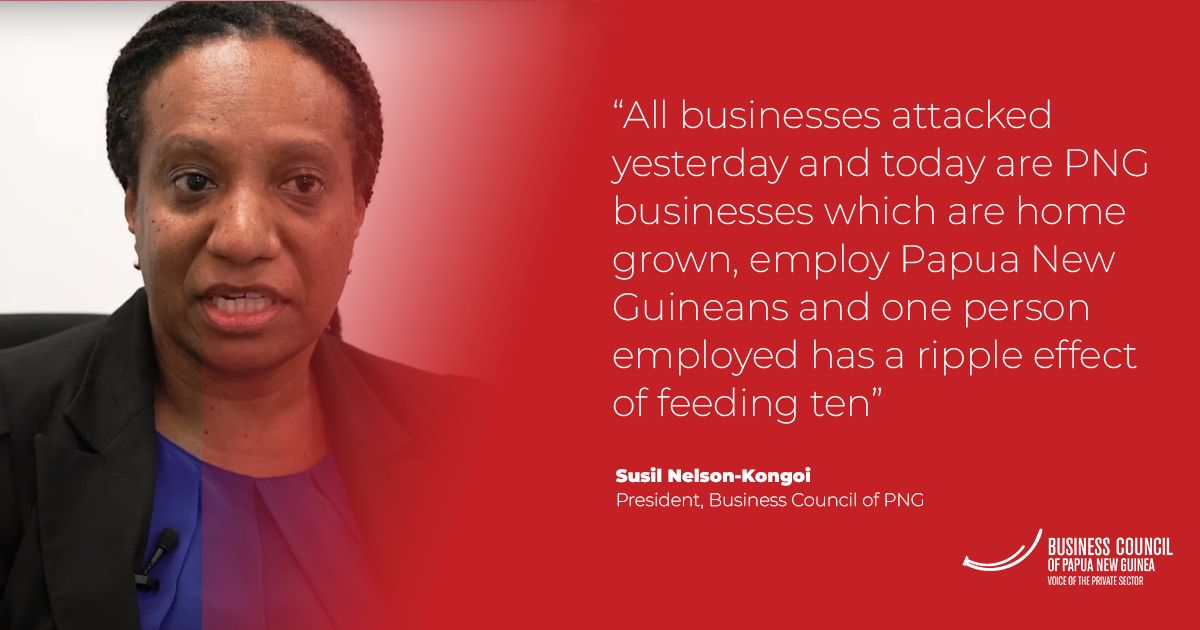 The President of the Business Council of Papua New Guinea, Mrs. Susil Nelson-Kongoi, has expressed deep concern over the recent wave of looting in Port Moresby. Business houses in the capital city suffered significant financial losses, with millions of Kina lost in a single day, primarily due to public pressures related to tax increases and glitches in the public servants' payroll system.
Mrs. Nelson-Kongoi is appalled that the business houses in the Nation's Capital were left unprotected on Wednesday, January 10, 2024, resulting in properties being lost in fires and extensive damages through looting. Highlighting the impact on the private sector, Mrs. Nelson-Kongoi emphasized that Papua New Guinea is already a challenging destination for investments and relies on the private sector retailers to conduct business. She noted that all businesses targeted during the unrest are homegrown PNG businesses that employ local citizens. The Porgera mine, situated in Enga, distinguishes itself from other sites in Papua New Guinea due to the predominant presence of free gold in its ore components. Unlike other minerals, free gold stands alone and is retrieved in its pure form. Mining experts highlight that this type of gold can be efficiently and energetically recovered in significant quantities using gravity concentration methods.
THE PNG Government must do something to fix the foreign exchange (FX) issues in the country, before business credibility with suppliers is lost, says City Pharmacy Limited (CPL) Group founder Sir Mahesh Patel.
“We sent an order to our supplier in the Philippines in August, and today is November going to December,” he said. “They have not started processing the order. “They said ‘unless you pay your bills, we will not process (the order)’. “We have got Kina to pay, but no US dollars to send. “That is the biggest concern that we have right now. We (businesses) are losing credibility with our suppliers. 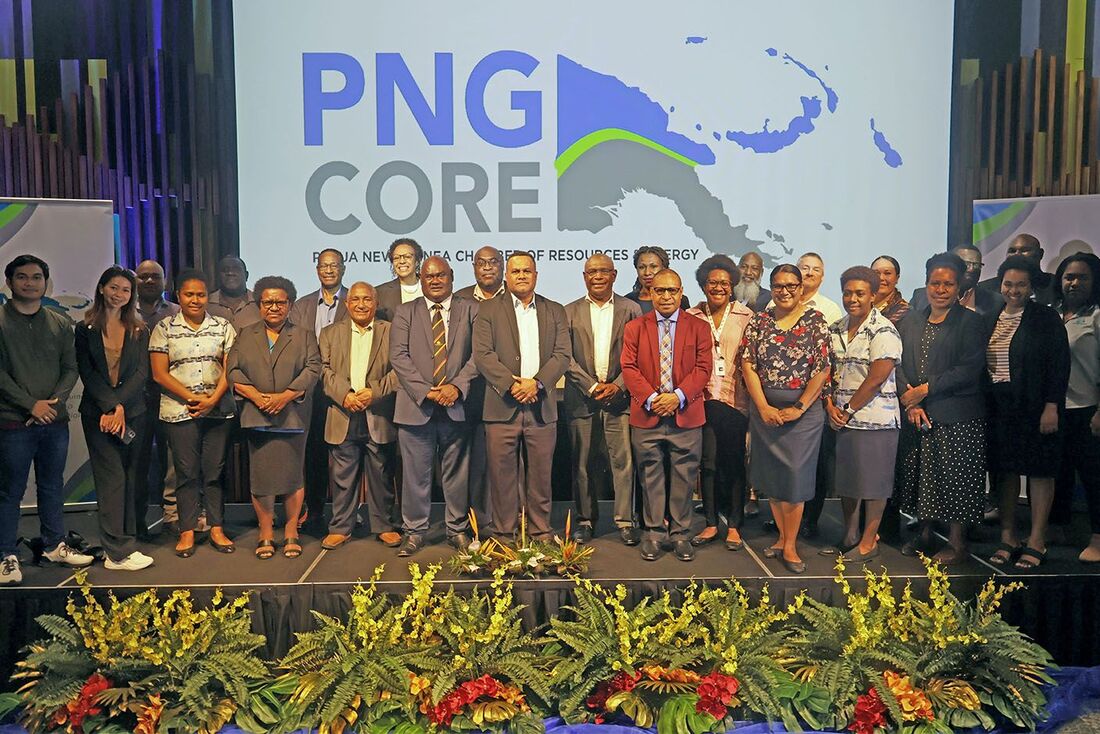 Photo: PNG CORE Councilor and Santos Country Chair PNG, Leon Buskens (Front, Centre) flanked by member representatives of PNG CORE at the launch of the Chamber’s new name and logo. Photo: PNG CORE Councilor and Santos Country Chair PNG, Leon Buskens (Front, Centre) flanked by member representatives of PNG CORE at the launch of the Chamber’s new name and logo. PAPUA NEW GUINEA CHAMBER OF RESOURCES & ENERGY
The industry peak body representing the mineral, resources and energy sectors today officially announced its new name, and new logo. The former Papua New Guinea Chamber of Mines and Petroleum (“The Chamber”) this morning formally transitioned to its new name, the Papua New Guinea Chamber of Resources and Energy (“PNG CORE”). This followed the approval of this change by its membership at a recent Special General Meeting. According to PNG CORE Chief Operating Officer, Pansy Taueni-Sialis, this change is timely, as PNG positions itself as a leader the global resources and energy market.  BANK South Pacific Financial Group Limited (BSP) recorded a net profit of K187.3 million in the third quarter (Q3) of 2023, according to chief executive officer Mark Robinson.
Robinson told a Q3 investor update in Port Moresby yesterday that BSP was still the largest bank in the South Pacific with more than 3.5 million customer accounts and 16.3 million mobile and online transactions per month. “This 16.3 million is the average and that is growing at an annual rate of over eight per cent,” he said. “The 3.5 million customer accounts, the 125 branches – it is the largest network of financial institution across the South Pacific.” Net profit after tax in Q3 last year was K275.4 million.  By Ishmael Long
Banks and lenders require new homeowners to contribute equity before approving home loan applications because it shows that the homeowner is financially committed to the purchase. Equity is the homeowner's own money invested in the property, which reduces the bank's risk. When homeowners have their own money at stake, they are more likely to make mortgage payments responsibly and protect the bank's investment. This equity also acts as a buffer in case the property's value decreases; it ensures that the homeowner has something to lose if they don't fulfill their mortgage obligations. So, it's a way for banks to ensure responsible and committed homeownership. Let's imagine you want to buy a flat screen TV at Brian Bell that costs K1,000, but you only have K200 in cash. You ask your friend to lend you K800, and you promise to pay them back over time. To show that you're serious about buying the flat screen TV and paying back your friend, you decide to use your own K200 as your part of the purchase. This K200 is like the equity in buying the flat screen TV. K92 Mining Incorporated has secured a US$100 million (about K365 million) loan from Trafigura Pte Limited, a market leader in the global commodities industry, according to chief executive officer and director John Lewins.
“We are extremely pleased to be expanding our partnership with Trafigura, with a US$100 million ( about K365 million) loan and amended off-take agreement,” Lewins said in a statement. “Trafigura has been our offtake partner since the start of operations at the Kainantu Gold Mine, and these agreements reinforce our strong relationship with Trafigura.”  Creating Wealth, One Property At A Time : Real Estate Investment Insight Creating Wealth, One Property At A Time : Real Estate Investment Insight Commentary By Ishmael Long
Purchasing a rental property after buying your first home under the homeowner-occupied scheme can be easier due to a few reasons. One key factor is the use of equity and lease agreements. Let's break it down with simple examples: Using Equity - When you own a home and have been paying your mortgage, you build up something called "equity," which is the difference between your home's value and the remaining mortgage amount. This equity can act like savings that you can use to invest in another property. For example, if your home is worth K300,000 and your remaining mortgage is K200,000, you have K100,000 in equity. You might be able to use a portion of this equity as a down payment for a rental property. Lease Agreements - Having a lease agreement in place for the property you're living in can help with purchasing a rental property. A lease agreement is a contract where someone pays you rent to live in your property. Banks look at this rental income as extra money you can use to pay off your new mortgage. For instance, if you're renting out a one bedroom unit in your first home for K2,000 a month, banks may consider that as extra income when deciding if you can afford a mortgage for the rental property. |
Papua New Guinea Business NewsWe cover all Papua New Guinea and International business news on this page. Please subscribe to our latest business on the subscribe form available on this page. 
|

- Home
- News
- Business News
- Economy News
- Sports News
- International News
- Corruption News
- Mining Watch
- Jobs
- Education News
- Scholarships
- Health News
- Bzzmart Online Shopping Platform
- Pacific
- Used Cars
- Buy or Rent Homes
-
Travel
- City of Port Moresby
- Adventure and Destination
- Hotels & Lodges in PNG
- Hotels & Lodges in Mendi, Southern Highlands Province
- Hotels & Lodges in Lorengau, Manus Province
- Hotels in Oro Province
- Hotels and Lodges in ESP
- Hotels & Lodges in Kavieng
- Hotels and lodges in Kimbe
- PNG Photo Gallery
- Map of Papua New Guinea
- PNG
-
Computer Tech
- Tech Help
-
Top Weebly designed Websites
>
- HOW TO RECOVER FILES WITH SHORT CUTS OR HIDDEN IN FLASH DRIVE OR EXTERNAL HARD DRIVE
- How to remove Stubborn Computer Virus
- Creating Login or Sign in Membership page in Weebly sites
- How to auto insert Table of Content in Word
- Top Weebly Website Examples and Portfolio
- Weebly Membership Sign in feature available
- Send Free SMS in PNG
- Radio Stations
- Television stations >
- PNG Information Directory
- Computer Resources
- Classifieds
- About us
- Contact Us
- Competition
- Advertisement
- Privacy Policy
- SP PNG Hunters News
- Weebly Forums
- National Football Stadium, Port Moresby
- Work Permits and VISAs in PNG : Guide
- Seasonal Workers Program for PNG
- List Your Business on PNGFacts.com
- Twodot Business Solutions
- Become a Sponsor
- Mt Giluwe Lodge
- Papua New Guinea Defence Force
- Political parties in PNG
- NID PNG
- Employment VISA in PNG
- Business VISA
- Visitor VISA
- Police Clearance in Solomon Islands
- PNG Electoral Commission
- PNG Election Results
 RSS Feed
|
Search Papua New Guinea Database >>
|
|
|
|
|
Home: PNG News :Travel : Government System: Computer Tech : About us: Contact : Disclaimer : Sitemap : Login Copyright & Disclaimer © 2012 -2023 PNG Facts: All rights reserved:
|
Website developed by Kilikalo Technology & Business Solutions Ltd
About |
Terms |
|